Kabuto Yakushi

He carried seven identities. Not one of them was his — and in the end he had to admit that all of them were.

After the battle at Kikyō Pass a boy was found on the field who could not even give his name. In the years that followed he was everyone in turn: the orphanage child, the friendly exam candidate, Root's agent, the surgeon, a serpent's shadow, the owner of an army. This page turns that deck over, one card at a time.

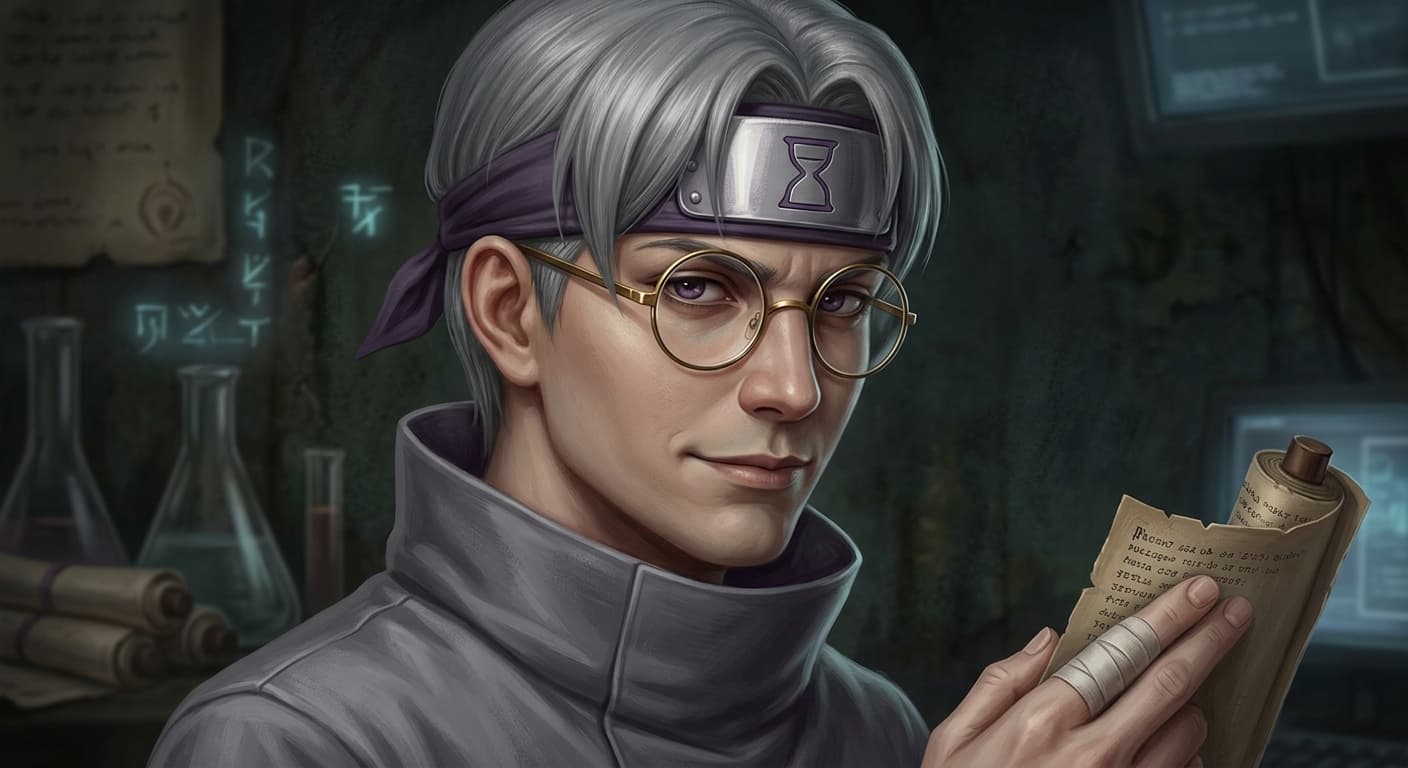
Kabuto Yakushi — AniList profile portrait

Profile portrait · AniList · ~230 px

9 rows · 2 empty

The file

Two fields on the AniList record are filled and two are empty. Rather than invent the empty ones we left them empty: on the file of a man whose identity was erased, a missing row is the story itself.

Birthday
29 FebruaryA date that comes round once in four years. The AniList record carries no year.
Age
No entryThe age field on the AniList record is empty; the archive leaves it empty too.
Blood type
AB
Rank on file
GeninHe never rose a step in the Konoha registry.
Chūnin exam
Entered seven timesNot for promotion: the exam was a collection ground for him.
Chain of allegiance
Konoha Medical Unit → Root → Otogakure → Akatsuki (as a partner)
His entry in the registry
ErasedErased the day Root took him — the most valuable trait an agent can have.
What he carries
A pair of round glasses and a deck of info cards
Appears in
Naruto (2002) · Shippuden (2007) · Boruto (2017)

3 major techniques

The laboratory

All three are settings of a single idea: open a body, look inside, and put what you want in there. In Kabuto's hands there is no border between medicine and jutsu.

  • Kuchiyose: Edo Tensei

    Impure World Reincarnation

    The technique Orochimaru left unfinished. Kabuto is the one who completed it.

    It calls a soul back from the other world, binds it into a living sacrifice, and returns the dead to the field with every power they held in life. Orochimaru could push the technique as far as two Hokage; Kabuto took it to the scale of an army. The lock he added himself is the coldest part: he can suppress the revived person's will and reduce the body to a puppet that cannot refuse. In the Fourth Great Shinobi War he carried half the war alone — not with his own hands, but with other people's corpses.

    • Returns the dead at full strength
    • The body cannot die, the chakra cannot run out
    • The will can be suppressed
  • Iryō Ninjutsu · Chakra no Mesu

    Medical Ninjutsu & Chakra Scalpel

    The same hand stitches and cuts; which one it does is a matter of intent, not of skill.

    Kabuto can spread chakra across his palm to close a wound, or gather the same chakra to the thinness of a blade and cut the muscle, vessel and nerve inside without ever breaking the skin. It needs no hand seals, so it works mid-fight, at the distance of a handshake. The medic's diagnostic reflex has become a weapon in him: he knows where an opponent is weak before that opponent does.

    • A blade that cuts without breaking skin
    • Needs no hand seals
    • Diagnosis is the weak point
  • Sennin Mōdo

    Snake Sage Mode

    The one guest the white snake of Ryūchi Cave could not digest.

    In Ryūchi Cave he learned to gather senjutsu chakra, and the change stayed with him: scales across the skin, a split pupil, a horn at the brow. Sage mode gave him not only power but perception — a sense that reads every chakra around him. It is also the page's own mode switch: the state in which Kabuto's search for an identity ends, and his body no longer has to resemble anyone else's.

    • Ryūchi Cave
    • Scales and a slit pupil
    • A permanent transformation

4 items

The smaller instruments

Not the techniques that fill a page — the instruments that finish a job. All four run on information or on somebody else's body.

  • Info cards

    The cards look entirely blank; the writing surfaces only under Kabuto's chakra. Steal the deck and you still cannot read it — the information belongs to the carrier, not to the card.

  • Changing identity

    The technique itself is ordinary: every genin knows Henge no Jutsu. What sets Kabuto apart is holding the disguise for months — he imitates not a face but a life.

  • Shiryō no Jutsu

    It raises a dead body with chakra and walks it like a puppet. In the Forest of Death he sent his own corpses at his opponents and gathered what he needed without having to fight at all.

  • The graft

    After Orochimaru died he took his master's remains into his own body, then rewrote himself with cells harvested from his master's former subjects. Even his body is assembled out of other people's parts.

8 cards · 7 identities + 1 blank

The identity deck

Kabuto's life is made of tactical identities. Draw from the deck: the drawn identity comes to the centre, the earlier ones stack aside, the remaining count falls. There is nothing written on the eighth card.

card1/ 8

Kikyō Pass, after the battle

The child with no name

When he was found he could give neither his name nor where he had come from. Nono Yakushi of the Konoha Medical Unit brought him back to the village, took him into her orphanage and gave him her own surname. The round glasses come from those years too. Even his first identity was somebody else's gift.

What it was for
To have somewhere to be.
What it left behind
A surname and a pair of glasses.

7identities left

A face-down stack of identity cards — hand-drawn card backs.

Identities drawn

You can go back into any drawn card from the stack, and move between them with the left and right arrow keys.

1 / 8 — The child with no name

3 records · 1 is his own

The info cards

The cards are born blank; the writing surfaces only under Kabuto's own chakra. This is how he carried his rivals' files into the Chūnin exam. Information is power — and the back of every card is empty.

  • Record

    Rock Lee

    Squad

    Team Guy — Konohagakure

    The card's line

    Cannot use ninjutsu or genjutsu. All he has is taijutsu.

    Back of the card

    blank

    He read this line out to Konoha's rookies himself before the exam; the card's job was not to belittle a rival but to put the listener in his debt.

  • Record

    Gaara

    Squad

    Sunagakure — the sand siblings

    The card's line

    He has come back from every mission without a single scratch.

    Back of the card

    blank

    The most dangerous line on the card is not a measure of power but an absence: no record of damage at all.

  • Record

    Kabuto Yakushi

    Squad

    The card's line

    Back of the card

    blank

    An info card tells you everything about the person it records and nothing about the person who wrote it. Kabuto's own line stayed empty for years — and he was the one who kept it empty.

5 entries

Five pages of the file

Five entries: a foundling, an erasure, a killing, a long service, and at the end a loop that breaks.

  1. Childhood

    Found without a name

    When the fighting at Kikyō Pass ended he was the only child left standing on the field, and he could not say who he was. Nono Yakushi of the Konoha Medical Unit gathered him up, brought him to the orphanage and gave him a name and a surname. Even the first letter of his identity was written by someone else.

  2. The end of childhood

    Danzō erases the record

    Root took him over as a spy. What Danzō gave in return was not protection but absence. His entry in the Konoha registry was erased, his childhood at the orphanage turned into a cover, and for years he worked by wearing other people's lives. He picked a name on the way to every mission and left it behind on the way back.

  3. Youth

    The woman he did not recognise

    On a Root mission he came up against a masked enemy agent; both of them were there under a false identity. After he killed her, Kabuto saw that the face beneath the mask was Nono's — and Nono, dying, did not recognise him. That night the last tether of his identity snapped: no one was left who remembered him.

  4. The long years

    Living inside a shadow

    Orochimaru gave him a role rather than a refuge, and Kabuto put it on gladly: he mixed the drugs, filed the subjects, kept up the spying and never made a single move on his own account. When his master fell to Sasuke he took the remains into his own body and tried, for the first time, to speak for himself. How much of that voice was his own remained unclear.

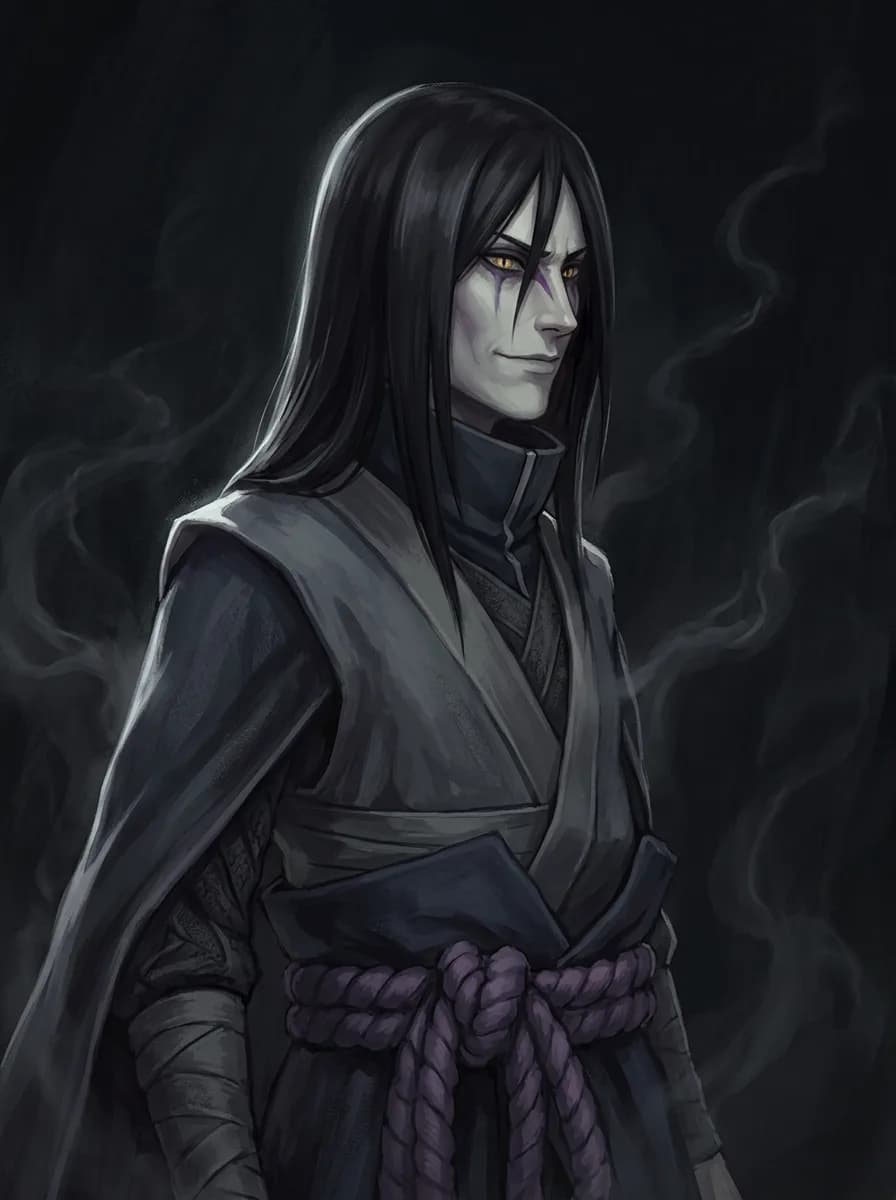
    Orochimaru — cast portrait uploaded to the archive
    Orochimaru
  5. The war

    The loop breaks

    He entered the Fourth Great Shinobi War with an army of the dead and set the direction of the war by himself. What stopped him was not a superior technique: Itachi Uchiha locked him inside his own moments with Izanami. The loop only ended when Kabuto accepted himself as he was. He undid Edo Tensei with his own hands, and after the war returned to Nono's orphanage and stayed there.

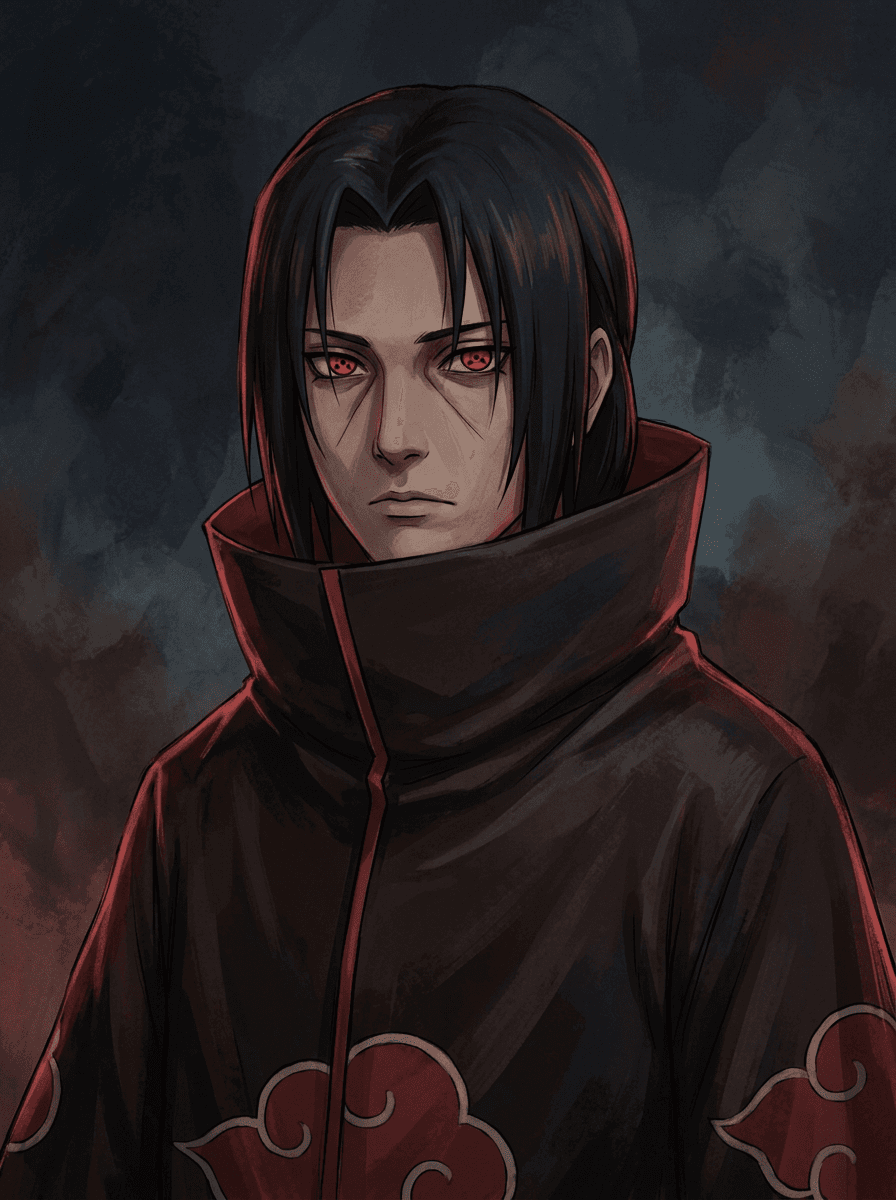
    Itachi Uchiha — cast portrait uploaded to the archive
    Itachi Uchiha

Kabuto Yakushi

I am me.
Kabuto YakushiThe answer he reached on his way out of Izanami's loop. The rendering is the archive's own, and this is the only quoted line on the page.
so who are you?
The last card in the deckThis line belongs to no character: it belongs to the blank card in the deck — the archive's question to the reader.

edo tensei — “rebirth from impure earth”. The name of his greatest technique is also the summary of his own life.

Profile data (birthday, blood type) and the cover portrait come from AniList; this character has no full-size portrait uploaded to the archive, so the portrait is kept small and at its own scale. The spectacles, card backs, identity marks, scale texture and suture marks are SVGs drawn by hand for this page. AniList profile